


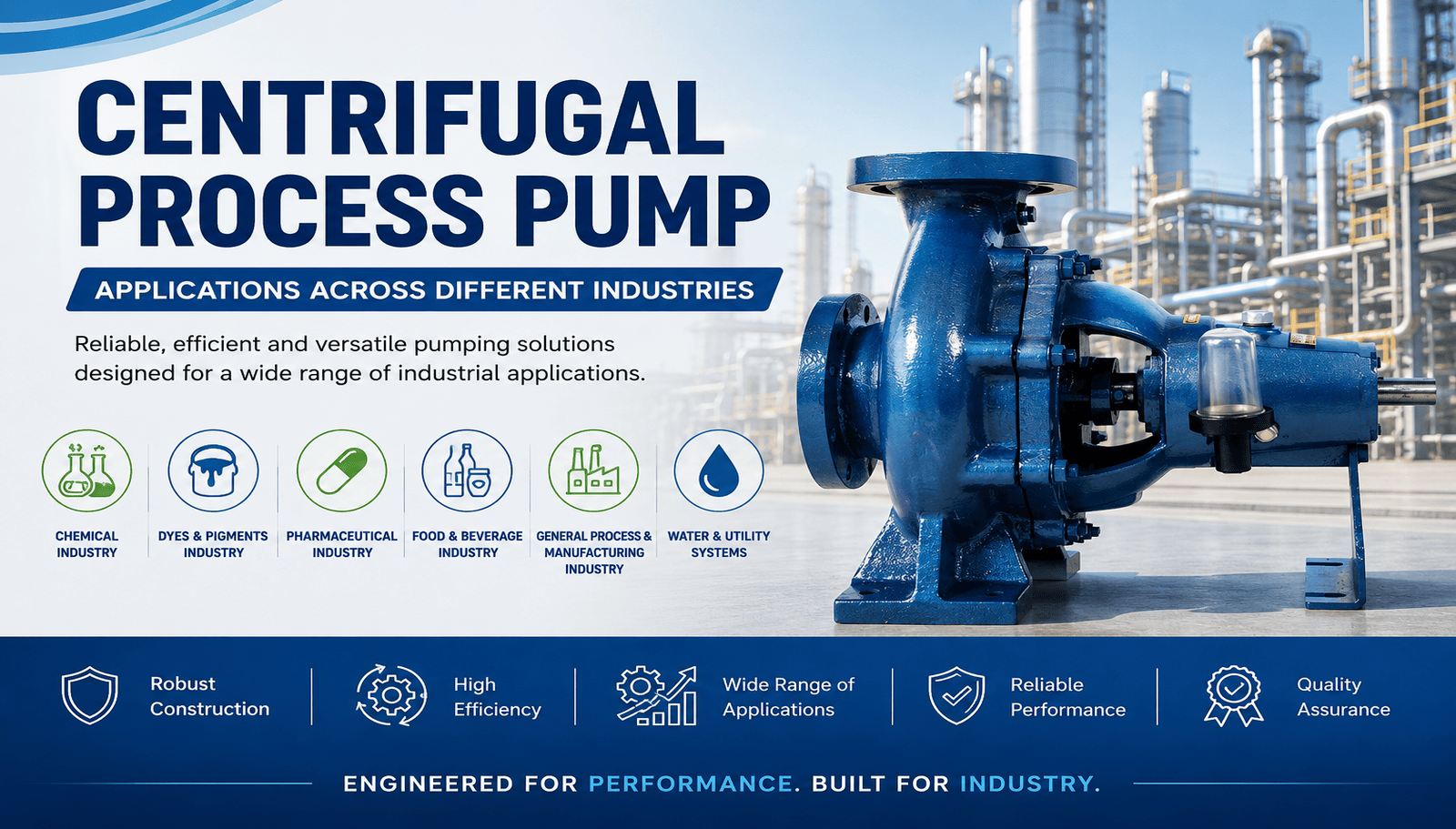
Centrifugal Process Pump Applications Across Different Industries
In industrial manufacturing, the reliable movement of liquids is essential for maintaining continuous production. From chemical processing and pharmaceuticals to dyes, pigments, food processing, and other manufacturing operations, the right pump plays an important role in transferring and circulating process fluids.
A Centrifugal Process Pump is one of the most widely used solutions for industrial liquid handling because of its continuous flow, robust construction, and ability to handle different operating conditions.
But selecting the right centrifugal process pump is not simply about choosing a pump with the required capacity. The fluid, temperature, pressure, material compatibility, operating conditions, and application must all be considered.
What Is a Centrifugal Process Pump?
A centrifugal process pump is a dynamic pump designed to transfer liquids by using the centrifugal force generated by a rotating impeller.
When the impeller rotates, it transfers energy to the liquid and moves it towards the outer portion of the impeller. The pump casing converts this energy into pressure, allowing the liquid to flow through the discharge pipeline.
The basic working principle is:
Liquid Inlet → Impeller Rotation → Energy Transfer → Pressure Generation → Liquid Discharge
Because the pump provides continuous liquid flow and can be manufactured using different materials and configurations, it is suitable for many industrial process applications.
Major Industrial Applications of Centrifugal Process Pumps
1. Chemical and Acid Industries
Chemical manufacturing involves the handling of different liquids, chemicals, solvents, and process fluids. Pump reliability and material compatibility are especially important in these environments.
Centrifugal process pumps can be used for suitable chemical transfer, circulation, and process applications where the pump construction is compatible with the fluid.
Depending on the chemical properties and operating conditions, materials such as SS-304, SS-316, SS-316L, carbon steel, cast iron, CD4MCU, and other alloys may be considered.
For highly corrosive, abrasive, or difficult-to-handle fluids, specialized chemical process pumps or other pump technologies may be more appropriate.
2. Dyes, Pigments and Solvent Industries
Dyes, pigments, intermediates, and solvent-based manufacturing processes require dependable fluid transfer between storage tanks, processing equipment, and different stages of production.
Centrifugal process pumps can be used for suitable liquid transfer and circulation applications where the fluid properties and pump materials are properly matched.
Material selection, sealing arrangement, temperature, and chemical compatibility are important factors when selecting a pump for these applications.
3. Pharmaceutical Industry
Pharmaceutical manufacturing requires controlled and reliable handling of process liquids. Pump selection must consider the nature of the fluid as well as the cleanliness and process requirements of the application.
Centrifugal process pumps can be used for suitable liquid transfer and circulation within pharmaceutical manufacturing processes.
Depending on the application, appropriate stainless-steel construction and sealing arrangements may be required to meet process requirements.
4. Food and Beverage Industry
Food and beverage manufacturing involves the transfer of various liquid products and process fluids throughout the production facility.
Centrifugal pumps can be used for suitable applications involving liquids such as water, beverages, liquid ingredients, and other process fluids.
For these applications, material compatibility, temperature, viscosity, cleanliness, and the nature of the product should be considered before selecting the pump.
5. General Process and Manufacturing Industries
Many manufacturing plants require continuous liquid circulation and transfer as part of their production or utility systems.
Typical applications can include:
- Process liquid transfer
- Tank-to-tank transfer
- Process circulation
- Cooling systems
- Utility liquid transfer
- Equipment circulation systems
For heavy-duty industrial environments, pump construction, bearing arrangement, shaft design, sealing system, and material selection can all influence reliability and service life.
6. Industrial Cooling and Circulation Systems
Industrial equipment often requires continuous cooling to maintain stable operating temperatures.
Centrifugal process pumps can be used to circulate suitable cooling fluids between equipment, tanks, heat exchangers, cooling systems, and other process components.
For applications operating continuously, selecting a pump with the correct hydraulic performance and efficiency can help reduce unnecessary energy consumption and improve system reliability.
7. Industrial Water and Utility Systems
Manufacturing facilities use water and other utility fluids for various supporting operations. These systems may include equipment cooling, process water circulation, utility transfer, and other plant requirements.
Centrifugal process pumps can provide continuous flow for suitable industrial water and utility applications.
The required flow rate, total head, temperature, pipeline arrangement, and operating hours should be evaluated before selecting the pump.
Why Material Selection Is Important in Industrial Process Pumps
Industrial fluids can vary significantly in their chemical and physical characteristics. A pump that works well with one liquid may not be suitable for another.
This is why the construction material of the pump should be selected according to the application.
Depending on the operating conditions, centrifugal process pumps can be manufactured with materials such as:
- Cast Iron
- Carbon Steel
- SS-304
- SS-316
- SS-304L
- SS-316L
- CD4MCU
- Other suitable alloy materials
Material selection should be based on factors such as corrosion resistance, fluid temperature, chemical concentration, pressure, and other application requirements.
Centrifugal Process Pump Features for Industrial Applications
Modern industrial process pumps are designed to provide reliable performance under demanding operating conditions.
Important features can include:
- Heavy-duty shaft construction
- Dynamic balanced rotating components
- Oil or grease lubricated bearings
- High-efficiency operation
- Speed variability options
- Mechanical seal or gland packing options
- Different material construction options
The exact configuration should be selected according to the specific process and operating requirements.
Centrifugal Process Pump vs Other Industrial Pump Types
Not every industrial liquid-handling application requires the same type of pump. Different pump designs are suited to different fluids and process requirements.
| Pump Type | Typical Industrial Application | Key Characteristic |
|---|---|---|
| Centrifugal Process Pump | Chemical, dyes, pigments, solvents, pharmaceuticals, food & beverage and general process industries | Continuous flow and versatile industrial operation |
| Diaphragm / AODD Pump | Chemicals, difficult fluids, abrasive fluids and applications requiring positive displacement | Suitable for challenging fluid-handling conditions |
| Vertical Multistage Inline Pump | Pressure boosting, HVAC, industrial water systems, RO and high-pressure applications | Multiple stages provide higher pressure in a compact design |
How to Select the Right Centrifugal Process Pump?
Choosing an industrial process pump requires more than simply selecting a motor with a particular horsepower. The complete application should be evaluated before finalizing the pump.
Flow Rate
Determine the required liquid flow in m³/hr, LPM, or another appropriate unit.
Total Head and Pressure
The pump must provide sufficient head and pressure to overcome pipeline losses, elevation differences, and process-system resistance.
Fluid Type
Identify the exact liquid being pumped, including its viscosity, density, temperature, chemical properties, and concentration.
Material Compatibility
The casing, impeller, shaft, sealing arrangement, and other wetted components should be compatible with the fluid.
Operating Temperature
Temperature affects material selection, sealing, viscosity, and overall pump performance and should therefore be considered during selection.
Why Correct Pump Selection Matters
An industrial pump is often expected to operate for long periods under demanding conditions. Selecting the correct pump can help improve reliability and reduce unnecessary operating and maintenance costs.
An incorrectly selected pump can result in:
- Insufficient flow or pressure
- Higher energy consumption
- Frequent maintenance
- Premature component wear
- Process interruptions
- Reduced equipment life
Final Thoughts
Centrifugal process pumps are an important part of modern industrial fluid-handling systems. Their applications extend across chemical, dyes and pigments, pharmaceutical, food and beverage, process manufacturing, industrial cooling, and utility systems.
However, every industrial application has different requirements. Flow rate, head, pressure, temperature, fluid characteristics, material compatibility, sealing arrangement, and operating conditions should all be considered before selecting a pump.
Globe Star Engineers India Pvt. Ltd. is an industrial pump manufacturer offering centrifugal process pumps and other industrial pumping solutions for demanding applications.
If you are looking for a suitable centrifugal process pump for your industrial application, share your required flow, head, fluid type, temperature, and other operating details with our technical team.