


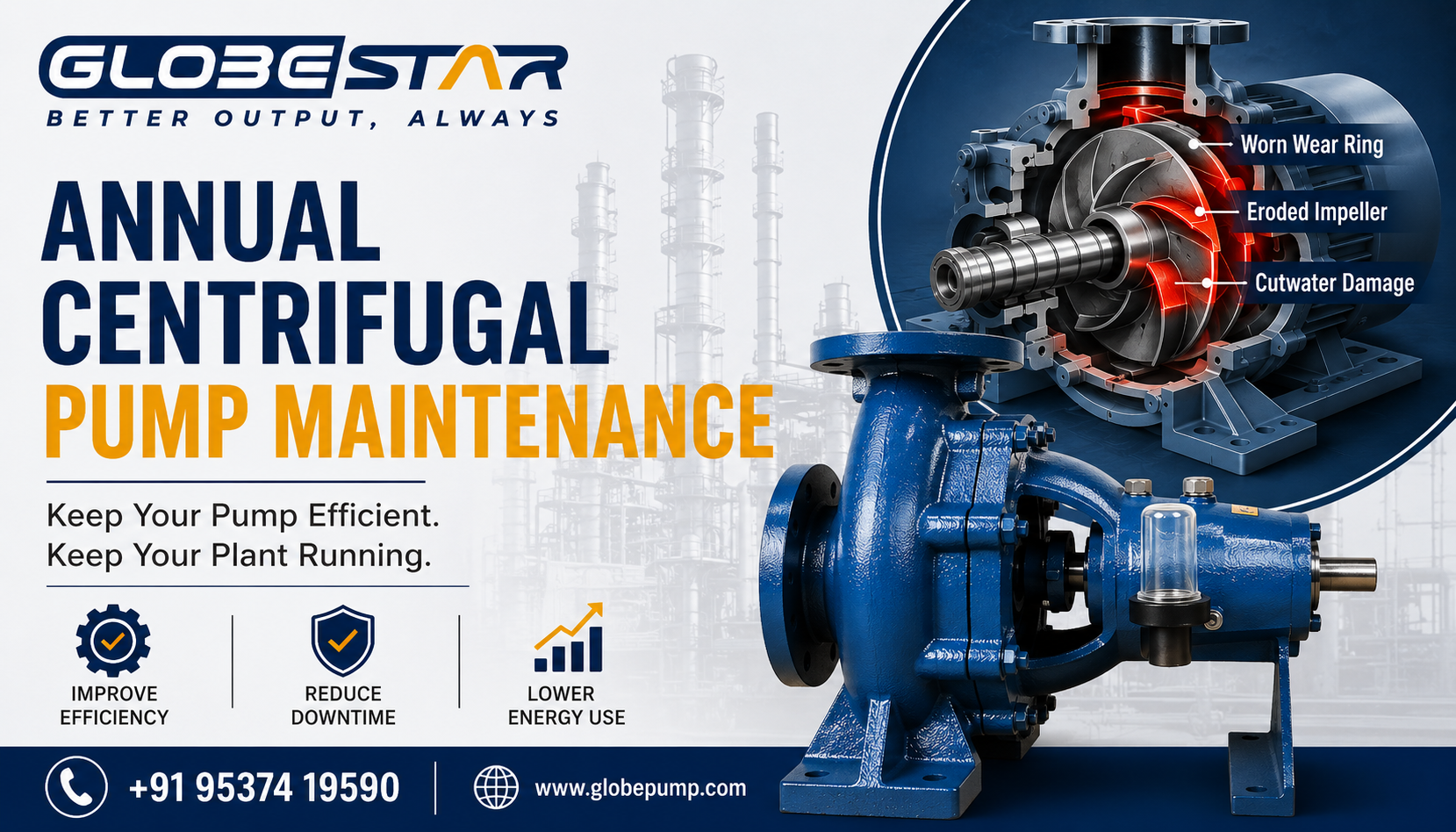
Why Annual Centrifugal Pump Maintenance Matters More Than Most Plants Realize
Many centrifugal pumps continue running every day while silently losing efficiency in the background.
There may be no visible leakage, no unusual sound, and no major vibration alarm — yet the pump may already be consuming more energy than necessary.
This happens because centrifugal pump problems rarely appear overnight. Most failures develop gradually over time.
As operating hours increase:
- Internal clearances slowly expand
- Hydraulic efficiency starts decreasing
- Recirculation inside the pump increases
- Wear develops on critical components
- Cavitation damage begins at a microscopic level
Long before a pump completely fails, its performance starts declining internally.
In many industrial applications, pumps can lose a noticeable portion of their efficiency before operators detect any obvious external warning signs.
Annual Maintenance Is More Than Basic Servicing
Routine tasks like lubrication, bolt tightening, and external cleaning are important — but they are not enough to restore pump performance.
A proper annual maintenance program is a planned reliability activity designed to:
- Recover hydraulic efficiency
- Reduce internal wear progression
- Improve operating stability
- Extend equipment lifespan
- Lower unnecessary power consumption
The goal is not simply to keep the pump running.
The goal is to return the pump closer to its original operating condition.
Data Collection Before Shutdown Is Critical
One of the biggest mistakes during maintenance is opening the pump without recording operating data first.
Before shutdown, important performance parameters should always be documented, including:
- Suction pressure
- Discharge pressure
- Flow rate
- Motor ampere load
- Bearing temperature
- Vibration readings
Without this baseline information, it becomes difficult to verify whether maintenance actually improved the pump’s condition.
The Hydraulic Section Requires Special Attention
Most hidden efficiency losses occur inside the hydraulic end of the pump.
During inspection, technicians should carefully evaluate:
- Impeller wear
- Cutwater erosion
- Wear ring clearances
- Internal recirculation paths
- Leading-edge damage on impeller vanes
Even a small increase in internal clearance can significantly impact pump efficiency and power consumption.
Unfortunately, these measurements are often skipped during standard servicing.
Effective Maintenance Depends on Diagnosis, Not Just Part Replacement
Replacing components without proper inspection does not guarantee improved reliability.
Professional pump maintenance focuses on:
- Measurement
- Condition assessment
- Performance comparison
- Root-cause identification
The success of maintenance should always be verified after startup by comparing operational data such as:
- Motor current
- Vibration levels
- Bearing temperatures
- Hydraulic performance
If performance remains unchanged after maintenance, the root issue may still exist — regardless of how many components were replaced.
Annual Maintenance Should Be Treated as a Reliability Strategy
Centrifugal pump maintenance is not simply a yearly shutdown task.
It is a condition-based reliability process that helps industries:
- Improve pump efficiency
- Reduce unexpected downtime
- Minimize energy losses
- Increase equipment life
- Maintain stable process performance
A structured maintenance checklist can help teams inspect critical areas systematically and avoid common blind spots during servicing.
Need a professional centrifugal pump maintenance checklist or technical guidance for pump inspection?
Contact Globe Star Engineering for expert support and pump maintenance solutions.