

Sewage Submersible Pumps: Complete Guide to Working, Applications, Selection & Maintenance
Introduction
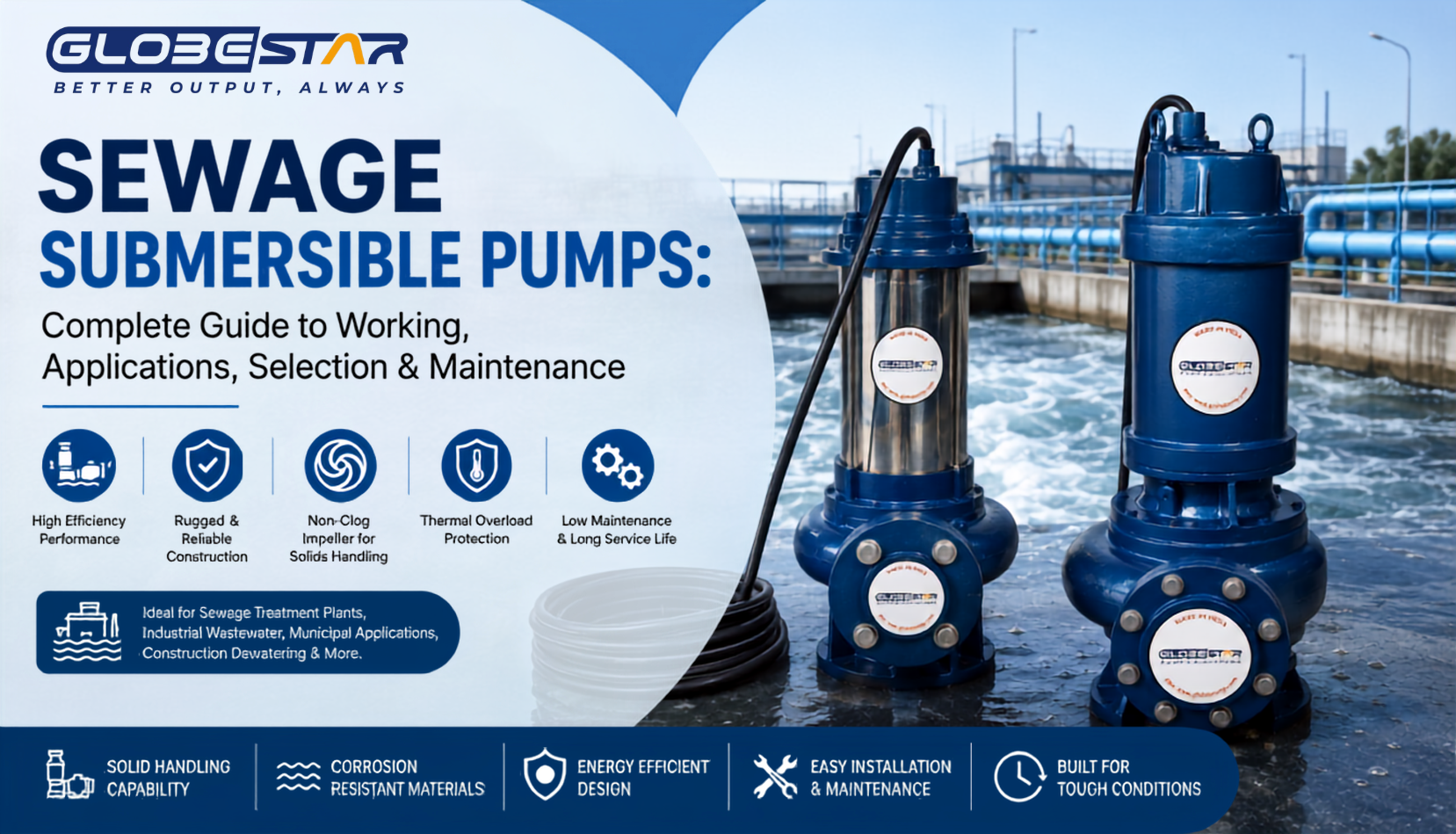
Sewage Submersible Pumps are specially designed to handle wastewater, sewage, sludge, and liquids containing suspended solids. These pumps operate while fully submerged in the pumped liquid, making them an ideal solution for municipal sewage systems, industrial wastewater treatment, residential drainage, construction dewatering, and floodwater management.
Compared to conventional surface-mounted pumps, sewage submersible pumps offer superior efficiency, compact installation, quieter operation, and lower maintenance requirements. Their robust construction and reliable performance make them one of the most widely used pumping solutions across various industries.
This comprehensive guide explains how sewage submersible pumps work, their key features, applications, material selection, pump selection criteria, maintenance practices, and the benefits of choosing the right pump for your application.
1. What is a Sewage Submersible Pump?
A sewage submersible pumps is a heavy-duty centrifugal pump equipped with a hermetically sealed electric motor that operates completely underwater. It is specifically designed to transfer sewage, wastewater, sludge, industrial effluents, and liquids containing suspended solids without clogging.
Since the pump operates below the liquid level, it eliminates the need for manual priming while ensuring efficient and continuous operation even in demanding environments.
2. How Does a Sewage Submersible Pump Work?
A sewage submersible pump consists of several important components including:
- Hermetically sealed electric motor
- Heavy-duty impeller
- Pump casing
- Mechanical seal
- Stainless steel shaft
- Bearings
- Power cable
When electrical power is supplied, the motor rotates the impeller, creating centrifugal force. This force draws wastewater into the suction inlet and pushes it through the discharge outlet.
Because the motor remains submerged, the surrounding liquid naturally cools the motor during operation, eliminating the need for external cooling systems while improving efficiency and extending service life.
3. Key Features of Sewage Submersible Pumps
- Fully submersible leak-proof construction
- Non-clog or vortex impeller for handling solids
- Heavy-duty cast iron or stainless steel construction
- Double mechanical seal for enhanced reliability
- Thermal overload protection for motor safety
- Compact design with minimal installation space
- Low maintenance operation
- High hydraulic efficiency
- Continuous duty performance
4. Common Applications
Sewage submersible pumps are widely used across numerous industries and municipal sectors.
- Municipal sewage lift stations
- Sewage treatment plants (STP)
- Industrial wastewater transfer
- Chemical processing industries
- Food and beverage plants
- Pharmaceutical manufacturing
- Residential and commercial wastewater systems
- Stormwater and floodwater pumping
- Construction site dewatering
- Mining and infrastructure projects
5. Material of Construction (MOC)
Selecting the appropriate material of construction is essential for ensuring long service life and reliable performance, especially when pumping corrosive or abrasive fluids.
| Component | Common Materials |
|---|---|
| Pump Casing | Cast Iron, SS304, SS316, Duplex Stainless Steel |
| Impeller | Cast Iron, SS304, SS316 |
| Shaft | Stainless Steel (SS410 / SS316) |
| Mechanical Seal | Silicon Carbide (SiC), Carbon Ceramic |
| Elastomers | NBR, EPDM, Viton |
| Fasteners | Stainless Steel |
The ideal material depends on the fluid's chemical composition, temperature, pH value, abrasiveness, and operating conditions.
6. Selection Criteria
Choosing the right sewage submersible pump is essential for achieving reliable performance, improved efficiency, and reduced maintenance costs. Before selecting a pump, consider the following factors:
- Flow Rate (m³/hr): Determine the volume of wastewater to be transferred.
- Total Dynamic Head (TDH): Calculate the total pumping head, including pipe friction losses.
- Solid Handling Capacity: Ensure the pump can pass the maximum particle size present in the liquid.
- Liquid Temperature: Select a pump suitable for the operating temperature.
- Chemical Compatibility: Choose appropriate materials for corrosive or aggressive liquids.
- Installation Method: Select guide rail mounted or free-standing installation depending on site conditions.
- Power Supply: Verify voltage, frequency, phase, and motor rating requirements.
- Operating Environment: Consider continuous duty, intermittent operation, or hazardous locations if applicable.
7. Advantages of Sewage Submersible Pumps
Sewage submersible pumps offer numerous advantages over conventional pumping systems, making them a preferred choice across industrial and municipal applications.
- No priming required as the pump operates below the liquid level.
- High efficiency with low energy consumption.
- Reliable handling of wastewater containing suspended solids.
- Compact design requiring minimal installation space.
- Quiet operation due to submerged installation.
- Reduced maintenance requirements.
- Long service life with heavy-duty construction.
- Lower operational and maintenance costs.
- Suitable for continuous and demanding applications.
- Excellent performance in confined or underground installations.
8. Maintenance Tips
Routine preventive maintenance helps maximize pump performance, reduce unexpected downtime, and extend equipment life.
- Inspect mechanical seals regularly for leakage.
- Monitor motor insulation resistance periodically.
- Clean the impeller and pump casing to prevent clogging.
- Check bearings for wear and unusual noise.
- Inspect electrical cables and power connections.
- Verify proper operation of float switches and control panels.
- Monitor vibration levels during operation.
- Replace worn components before failure occurs.
- Follow the manufacturer's recommended maintenance schedule.
Why Choose Globe Star Engineers (India) Pvt. Ltd.?
Globe Star Engineers (India) Pvt. Ltd. is a trusted manufacturer and supplier of high-quality industrial pumping solutions. Our sewage submersible pumps are engineered for reliable performance, high efficiency, and long service life in demanding industrial environments.
Our pumps are suitable for municipal wastewater systems, industrial effluent transfer, sewage treatment plants, construction dewatering, floodwater management, and various heavy-duty applications. With robust construction, premium materials, and expert engineering support, we help customers achieve dependable pumping performance while minimizing maintenance costs.
Conclusion
Sewage submersible pumps play a critical role in modern wastewater management by delivering efficient, reliable, and uninterrupted pumping performance. Selecting the right pump based on flow rate, head, material of construction, and application requirements ensures maximum operational efficiency and long-term reliability.
Whether you need a pump for municipal sewage systems, industrial wastewater transfer, sewage treatment plants, or construction dewatering, choosing a high-quality solution from Globe Star Engineers (India) Pvt. Ltd. ensures dependable performance, reduced downtime, and lower operating costs.
Looking for the right sewage submersible pump for your application? Contact our experts today for professional guidance and customized pumping solutions.